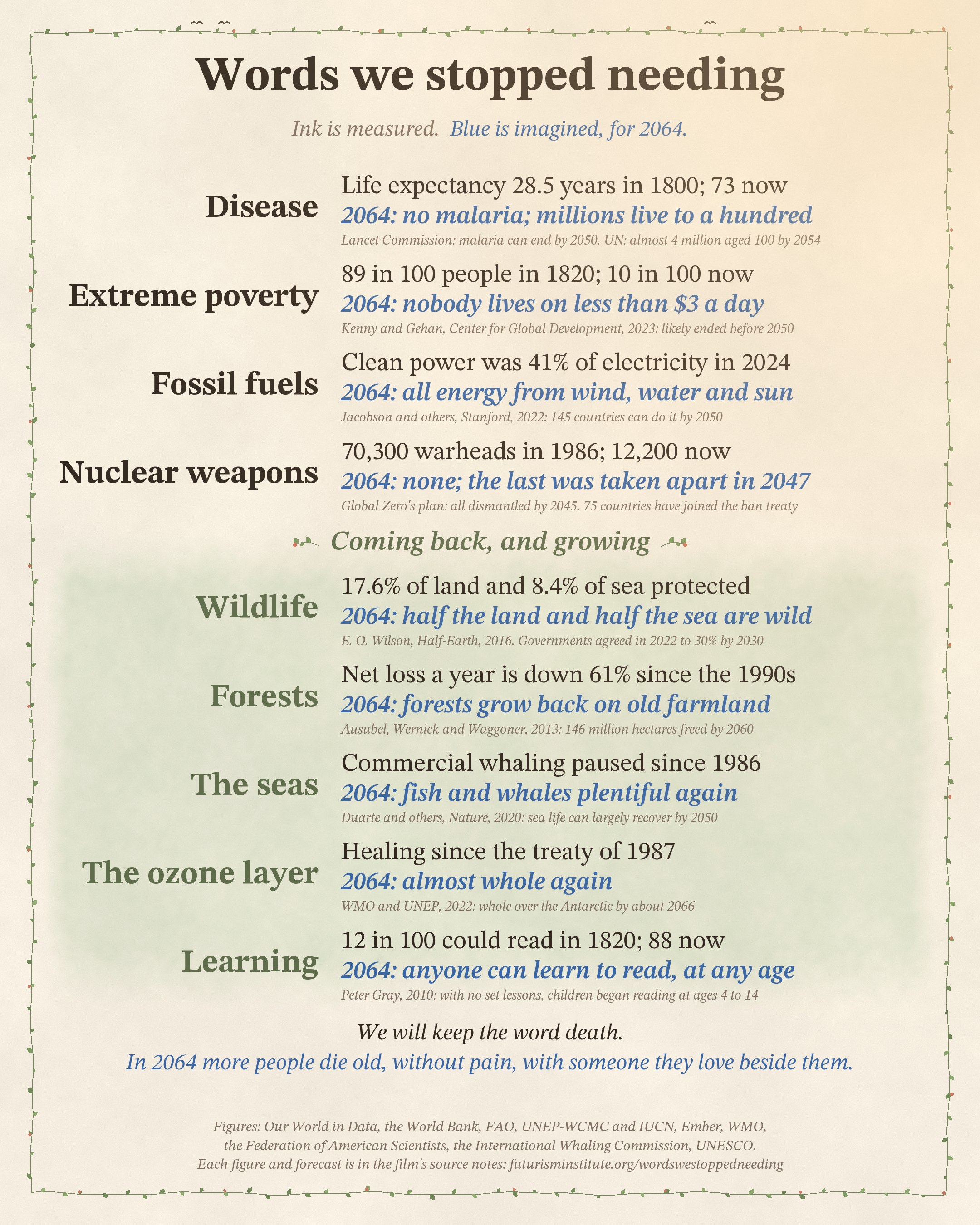
It opens on a hanging scroll that unrolls over a painted dusk while a counter runs from 10,000 BCE to 1800, with one sentence: for most of history, life expectancy at birth was about thirty years, in large part because about half of all children died before the age of fifteen. A lamp appears for every ten million people alive. Four lines then rise from 1800 to 2023: children who live to five, life expectancy, adults who can read, and people out of extreme poverty. The main chart has eleven rows of word cards sliding from 1915 to 2064; each card is a small line of how often English-language books used a word. Ten rows say how the thing ended: cured and prevented, clean water and air, enough to eat, outlawed and banned, old medicine, something better came along, normal now, engineered out, somehow still with us, and almost gone. The last row, coming back, counts animals and habitat returning, such as humpback whales, elephant seals and Costa Rica's forest. The captions, when turned on, add a short sourced line about one card at a time, saying what ended a word, and some are funny: a rat won a medal clearing landmines, and airliner toilets must still have ashtrays. Behind the rows each band of the land is drawn: mountains, a fir forest, orchards, fields, a river, a town lit at night, the sea and the soil. Each line stands on level ground in its own band, and the area under it is filled as that band's land: snow-capped rock, firs, orchard rows, furrows, roofs, a swell. After 2022 the lines are dashed blue and imagined. The biggest endings, from malaria to nuclear weapons and global warming, take their years from the Institute's film The Doomsday Clock, so the two imagine one future. Under the timeline's moving dot, each stretch of years is named, from AI we can check in 2030 to healthy to a hundred in 2058. At 1915 the four bands of land level out and become the chart's rows. At 2064 the cards and names fade and the rows of land rise into one painting: the valley the film opened on, as it might be in 2064, with a snow mountain, a planted forest, an orchard, a village of winding paths with houses under turf, felt tents, a wind pump, a pond and a commons strung with lamps, and beside it a hill town of stuccoed houses under tile roofs climbing to a hall with a dome and a bell tower, above a stone quay on the water, a boat under sail, and the same four people at the same fire, beside a roundhouse and a glasshouse, with a flower in the meadow for every word. Night falls and the lights come on. A scroll unrolls over the night with the film's last sheet: nine broad things, each with what is measured about it, the film's 2064, and in small type the forecast, plan or study that the 2064 line leans on. Four are going. Disease: life expectancy 28.5 years in 1800 and 73 now; in 2064 no malaria, and millions live to a hundred (the Lancet Commission says malaria can end by 2050; the UN projects almost 4 million people aged 100 by 2054). Extreme poverty: 89 in 100 people in 1820 and 10 in 100 now; in 2064 nobody lives on less than $3 a day (Kenny and Gehan, Center for Global Development, 2023: likely ended before 2050). Fossil fuels: clean power was 41% of electricity in 2024; in 2064 all energy from wind, water and sun (Jacobson and others, Stanford, 2022: 145 countries can do it by 2050). Nuclear weapons: 70,300 warheads in 1986 and 12,200 now; in 2064 none, the last taken apart in 2047 (Global Zero's plan has all dismantled by 2045; 75 countries have joined the ban treaty). Five are coming back, or growing. Wildlife: 17.6% of land and 8.4% of sea protected; in 2064 half the land and half the sea are wild (E. O. Wilson, Half-Earth, 2016; governments agreed in 2022 to 30% by 2030). Forests: net loss a year is down 61% since the 1990s; in 2064 forests grow back on old farmland (Ausubel, Wernick and Waggoner, 2013: 146 million hectares freed by 2060). The seas: commercial whaling paused since 1986; in 2064 fish and whales plentiful again (Duarte and others, Nature, 2020: sea life can largely recover by 2050). The ozone layer: healing since the treaty of 1987; almost whole again (WMO and UNEP, 2022: whole over the Antarctic by about 2066). Learning: 12 in 100 could read in 1820 and 88 now; in 2064 anyone can learn to read, at any age (Peter Gray, 2010: with no set lessons, children began reading at ages 4 to 14). Its last lines say we will keep the word death, and that in 2064 more people die old, without pain, with someone they love beside them. The scroll rolls up on the night the film began with. The music is quiet folk without drums; a singing bowl is struck once, at 2022.
Made for people who work to end a harm that still exists: a vaccine campaign, a city water utility, a ban on lead, a plan to bring back a species. It is also for the people who fund that work, teach it or vote on it. Most of these words left the books after someone acted with a vaccine, a law, a treaty or a better tool. The dashed lines after 2022 show what could end next if that work goes on. Free to share under CC BY 4.0, with credit to the Futurism Institute.